
A student struggles with the word “accueillir” for the third time in dictation. They are made to copy it ten times, remember the spelling for two days, and then forget it. The problem does not lie in their memory, but in the method: copying an isolated word does not create any lasting connection in the brain. Semantic games change the game because they link each word to a network of meanings, families, and contexts.
Morphological families: the lever that traditional quizzes ignore
Most spelling applications offer multiple-choice questions or fill-in-the-blank texts. You check, validate, and move on to the next word. The issue is that this format tests visual recognition without building understanding.
Games that exploit word families work differently. When a child manipulates the root “accueil” and connects it to “accueillir,” “accueillant,” “accueil,” they understand why the double “c” and the group “ueil” appear systematically.
Students who engage with the morphological family of a word write the silent letters better than those who memorize only the spelling, according to research shared by Plume Orthophonie. The meta-analyses by Bowers, Kirby, and Deacon, as well as Goodwin and Ahn, confirm a globally favorable effect of morphological teaching on writing.
Specifically, one can propose a card game where each player draws a root and must form as many derived words as possible within a limited time. Vocabulary is enriched, grammar is anchored, and recurring mistakes with prefixes (in-/im-, dé-/dés-) decrease because the child has understood the logic, not just memorized an image.
This approach can be found in the semantic games on Greg From Paris, which structure revision around the meaning of words rather than mere visual memorization.
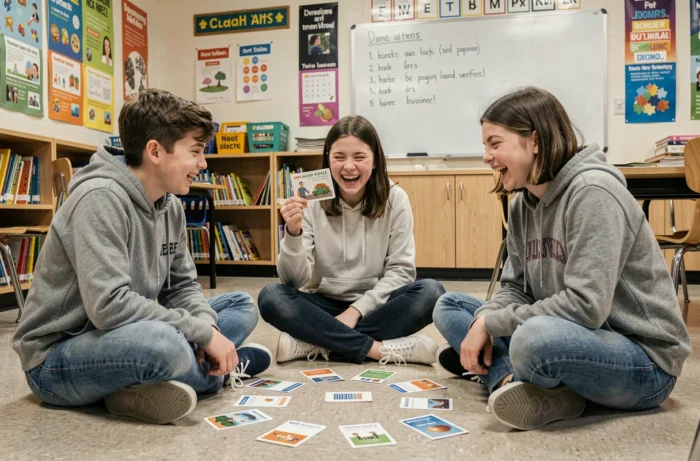
Semantic games and spelling: three formats that work in class or at home
Not all games are equal. A poorly calibrated format turns the session into playtime without learning. Here are three mechanics whose effectiveness relies on the link between meaning and spelling.
The prefix-root-suffix assembly game
Cards are distributed into three categories. Each player must compose an existing word by combining their cards. “Re-” + “bond” + “-ir” gives “rebondir.” “Dé-” + “couvr” + “-erte” gives “découverte.” The player who forms a valid word scores a point but must also use it in a correct sentence to double their score.
This double effort, assembly followed by writing, fixes both the structure of the word and its usage. Children remember that “découverte” takes an accent on the “e” because they have manipulated the suffix “-erte” several times during the game.
The homophone challenge in context
Homophones (ces/ses, et/est, a/à) are the primary source of mistakes in dictation. An effective game involves presenting two sentences where only the context allows for the correct spelling choice. The player reads aloud, justifies their choice in front of others, and corrects if necessary.
The oral justification forces the formulation of the rule, which enhances understanding far more than a simple click on the correct answer. Interactions between players also allow for adjusting the difficulty based on each person’s level.
The semantic intruder hunt
A list of five words is proposed, four of which share a common lexical field. The player identifies the intruder and explains why. For example: “nager, plonger, flotter, couler, voler.” The exercise works on vocabulary, attentive reading, and the ability to categorize, three skills directly linked to the quality of writing.

Spelling and digital tools: what AI changes for children
Spelling game applications are multiplying on the Play Store and the App Store. Some now integrate artificial intelligence to adapt exercises to the player’s level. It’s tempting, but the regulatory framework has evolved.
The French framework for the use of AI in education, published by the ministry on June 14, 2025, sets a clear limit: students must not directly manipulate generative AI services before the fourth grade. Beyond this age, uses must be defined and supervised by the teacher. A minor student cannot be required to create a personal account on a public AI service.
In practice, this means that a spelling application using a chatbot to correct answers is not suitable for primary school children without supervision. Feedback on this point varies by institution, but caution remains advisable.
- Check that the application complies with GDPR and does not collect personal data without explicit parental consent.
- Favor games where AI adjusts difficulty without direct interaction with a generative model (tiered exercises, for example).
- Systematically associate the digital tool with a physical playtime (cards, board) to vary memorization channels.
Digital accessibility is also a blind spot. An online game that relies solely on color contrasts or fanciful fonts excludes some students, particularly those with dys disorders. The best-designed platforms offer display customization options.
Adapting the level of semantic games according to age and recurring mistakes
A game that is too easy is boring. A game that is too difficult is discouraging. The key is to target the child’s actual mistakes rather than follow a generic program.
You can start by identifying the ten most frequent errors in the latest dictations or writings. These words become the basis of the game. If a child consistently confuses “ou” and “où,” we create specific sentence cards around this difficulty.
For younger children (cycle 2), oral and kinesthetic games work better: spelling a word while jumping once for each syllable, tracing letters on a classmate’s back. For cycle 3 and middle school, written challenges, board games like a revised game of goose, or team competitions around word families provide more.
A good semantic game makes you forget that you’re revising spelling. The child focuses on the challenge, competition, or cooperation, and the spelling rule is anchored through contextualized repetition. When we stop separating pleasure from learning, mistakes decrease sustainably.