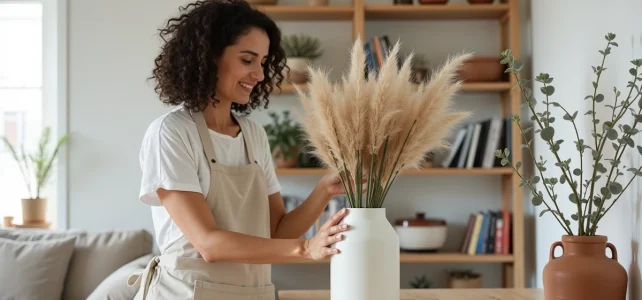
An interior that works relies less on the accumulation of decorative objects than on precise technical choices: selection of wall finishes, management of natural and artificial light, hierarchy of circulation. Transforming a space into a unique place requires treating these parameters as a system, not as a shopping list.
Lighting strategy: controlling natural and artificial light to transform a room
Light determines the perception of volumes even before choosing furniture or colors. We recommend mapping solar gains room by room, distinguishing between direct, indirect, and reflected light.
Read also : Tips for Equipping and Maintaining Your Home Like a Pro
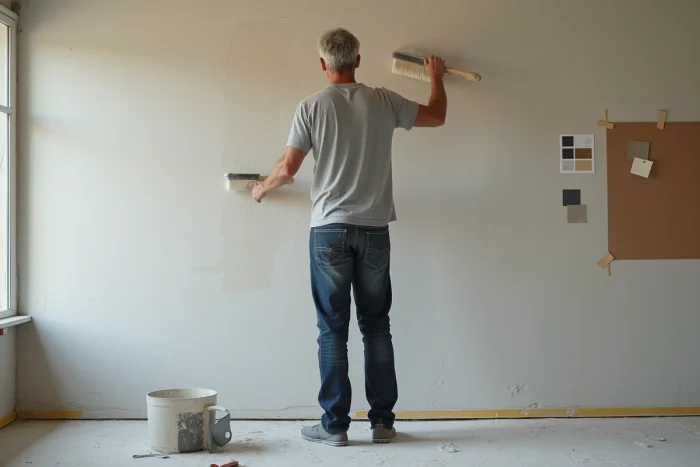
A north-facing wall does not react like a south-facing wall. Applying the same shade on both will produce two radically different atmospheres. Testing a paint sample on-site for 48 hours remains the only reliable way to assess the actual result.
On the artificial lighting side, multiplying sources at varying heights (low wall sconces, pendants, accent lamps) creates a depth that a single ceiling fixture cannot offer. A dimmer on each circuit allows for adjusting the color temperature throughout the day, which significantly alters the perception of space.
See also : Essentials to Revamp Your Interior with Unique Design Accessories
To explore concrete approaches to interior design and enhancing volumes, a useful resource is: https://www.perspectivemaison.com/, which addresses these topics with a project-oriented technical angle.
Dopamine decor and bold colors: stepping out of all-neutral without bad taste
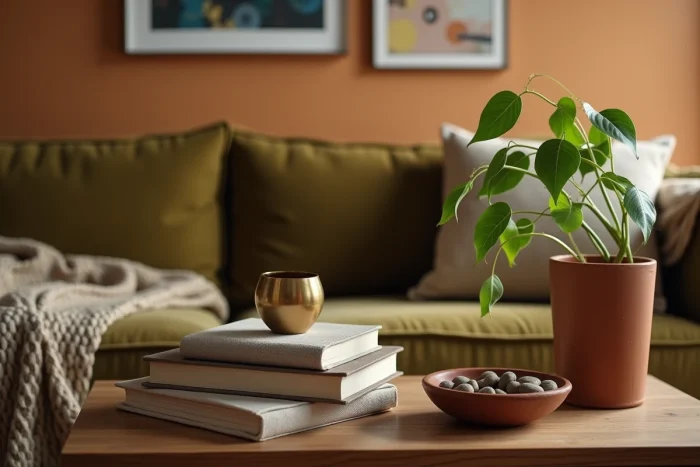
The so-called “dopamine decor” trend, validated by trend offices like WGSN and showcased at recent editions of Maison & Objet, marks a clear break from the beige-gray palettes that have dominated interiors for a decade. Individuals are daring to embrace bold contrasts and strong pieces: a painted ceiling, a sofa in a saturated hue, a two-tone wall.
A unique interior is born from a bold color choice, not from an accumulation of neutrals. The challenge lies in mastering proportions. We observe that a ratio close to 60-30-10 (dominant color, secondary color, accent) works in the majority of residential configurations.
Applying contrast without saturating the space
The classic pitfall is to multiply strong shades on all surfaces. An intense color gains impact when framed by sober areas around it. A living room with a deep blue wall and three off-white walls creates more effect than a living room where all four walls compete in color.
Warm colors (brick red, terracotta, mustard yellow) visually bring walls closer. Cool colors (teal, sage green) push them away. Playing with this perception allows you to correct the proportions of a room without altering the structure.
VOCs and interior decoration materials: a technical criterion overlooked by decor guides
Volatile organic compounds emitted by paints, wallpaper adhesives, particle boards, and certain textiles represent a health issue documented by the European Environment Agency. Decorating an interior without considering this parameter is akin to ignoring the air quality that one breathes for several hours a day.
- Paints: prioritize products rated A+ on the mandatory VOC label in France, and check the composition beyond the simple label (some A+ paints contain non-negligible amounts of residual solvents).
- Furniture: particle boards emit formaldehyde. Solid wood, metal, or glass furniture eliminates this problem at the source.
- Textiles: new curtains, cushions, and rugs release VOCs for several weeks. Washing before installation or prolonged airing of the room significantly reduces emissions.
Every decorative choice has a measurable health dimension. Integrating this criterion from the material selection phase avoids having to correct later with air purifiers, whose effectiveness remains limited in poorly ventilated homes.
Circulation and proportions: arranging the space before decorating
We regularly find that well-decorated interiors fail on one point: circulation. A passage of less than 80 cm between two pieces of furniture creates a physical discomfort that the brain translates into unease, even subconsciously.
Before purchasing a piece of furniture, marking its footprint on the floor with tape allows you to check that movement flows remain smooth. This method, common in commercial architecture, applies perfectly to residential settings.
Mirrors and perspectives: enlarging without pushing the walls
A mirror placed opposite a window doubles the perceived depth of a room and redistributes natural light. The effect works provided the mirror is large (at least the height of a door) and positioned at the right height to capture the main light source.
A large, well-placed mirror transforms a space more than three small decorative mirrors. Round mirrors or those with irregular shapes provide an interesting geometric break in a room with straight lines, but their enlarging effect is less than that of a full rectangular mirror.
- Narrow entryway: a full-length mirror on the back wall pushes back the visual limit and facilitates outfit checks before going out.
- Long living room: a side mirror facing the main light source widens the room without structural intervention.
- Attic bedroom: an angled mirror captures descending light and redistributes it to the darker low areas.
Transforming an interior into a unique space does not come from adding successive decorative layers. Light, color, air quality, and circulation management form a technical foundation. Once this foundation is properly laid, every added object finds its place effortlessly because the structure of the space does the work.