
The blue peafowl (Pavo cristatus) produces a cry that is unmistakable, a sort of powerful, nasal “leon” that can be heard for several hundred meters. This cry, far from being a mere vocal whim, serves specific biological functions that bioacoustic research is gradually illuminating. The species’ sound repertoire also includes components that are inaudible to the human ear, significantly broadening the scope of analysis.
Infrasound of the peafowl: an invisible signal beneath the audible cry
The audible cry of the peafowl, that famous shrill call, is just one part of its sound repertoire. Bioacoustic studies have revealed an additional layer: males in display emit low-frequency vibrations close to infrasound, perceived by females at short distances.
These vibrations cannot be heard by the human ear. They propagate through the ground and the surrounding air, enhancing the effectiveness of the sexual signal beyond what the visual display alone produces. Thus, the peafowl’s display is not just a spectacle of colors: it is a multimodal device where sound, including that which we do not perceive, plays an active role in female selection.
The peafowl’s cry therefore incorporates this infrasonic component, which alters the understanding of the species’ reproductive behavior. To learn more about the peafowl’s cry, one must consider this invisible acoustic dimension as much as the audible vocalizations.
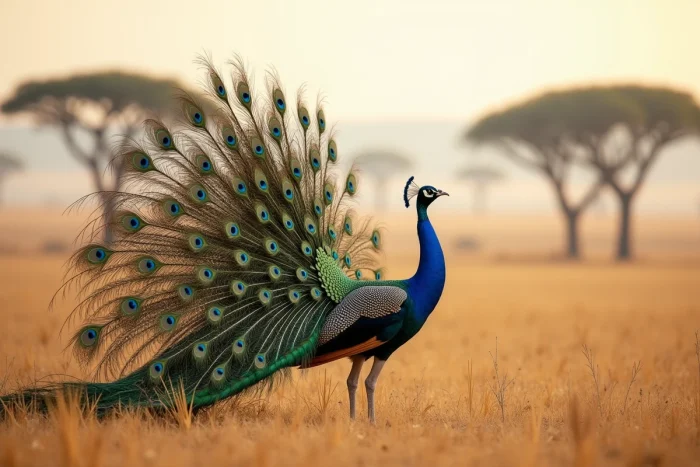
Peafowl cry and courtship display: three distinct functions
Reducing the peafowl’s cry to mere seduction would be a mistake. The vocal repertoire of Pavo cristatus serves at least three functions identified through field observations.
- Display call: the male emits repeated cries to attract the attention of females before and during the display, combining visual, auditory, and infrasonic stimuli into a coordinated signal.
- Territorial marking: outside the breeding season, males call to delineate their area, particularly at dawn and dusk. These vocalizations serve as warnings to potential rivals.
- Alert to predators: peafowl and peahens emit specific alarm calls when they detect danger. This behavior benefits the entire group, including chicks and other nearby species.
The frequency and intensity of the cries vary according to the context. A displaying male emits longer and more modulated vocalizations than an individual signaling a predator. Females, for their part, produce shorter and less powerful calls, but equally functional for communication within the group.
Noise issues of the peafowl: a problem of urban coexistence
The peafowl’s cry can reach a volume comparable to that of a car horn at close range. In captivity or in peri-urban areas, this vocal power becomes a real source of friction.
In several municipalities, both in India and the United States, the disturbance caused by the peafowl’s cry has sparked public debates and local regulations. Some municipalities have implemented restricted feeding times to limit nighttime and dawn sound activity. Others have considered relocating urban populations of peafowl that have become too noisy for residents.
Zoos face the same challenge. According to cases compiled by the Journal of Zoo and Aquarium Research in 2020, some shelters are adapting their enclosure plans to reduce disturbances: vegetation screens, minimum distances between aviaries and public areas, or even specific acoustic arrangements.
In France, the question also arises for individuals who raise ornamental peafowl. The bird must be registered with the town hall and marked, but no national regulation specifically addresses noise. Neighborhood conflicts related to the peafowl’s cry fall under abnormal disturbance, assessed on a case-by-case basis by the courts.

Male peafowl vs. female peafowl: different vocalizations
The male monopolizes attention with its display cries, but females also vocalize, with a distinct repertoire. The peahen emits more discreet calls, often associated with communication with her chicks or alarm signals.
The available data do not yet allow for a complete mapping of the vocal repertoire of each sex. Some observers report that females call more during the incubation period, while others note an increase in female vocalizations when a predator is detected. Research in animal ethology is progressing, but the peafowl remains a subject of study where many questions remain open.
Breeding season and vocal peak
The peak of vocalization coincides with the breeding season, typically in spring and early summer. Males then call almost continuously, sometimes from the first light of day. This seasonal intensification explains why noise complaints are concentrated in a few months of the year.
Outside of this period, the cries persist but at a reduced frequency, mainly related to territorial marking and occasional alerts.
The peafowl’s cry remains a subject of study at the intersection of bioacoustics, ethology, and urban wildlife management. Its infrasonic component, multiple functions, and the tensions it generates in inhabited areas form a richer whole than mere anecdotal curiosity. For individuals as well as park managers, coexistence with this bird involves a better understanding of what its vocalizations truly signify.